
Screenshots

Overview
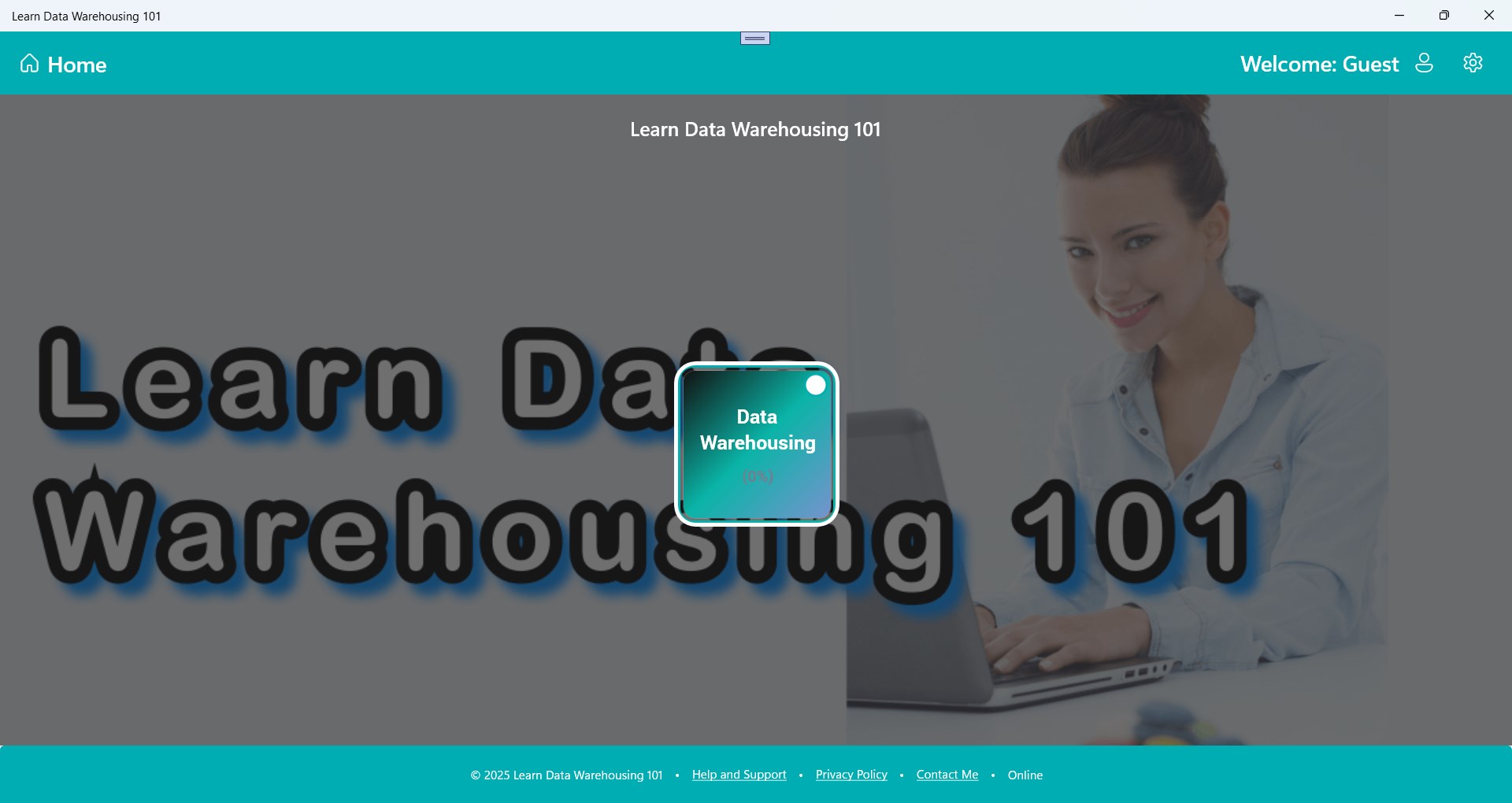
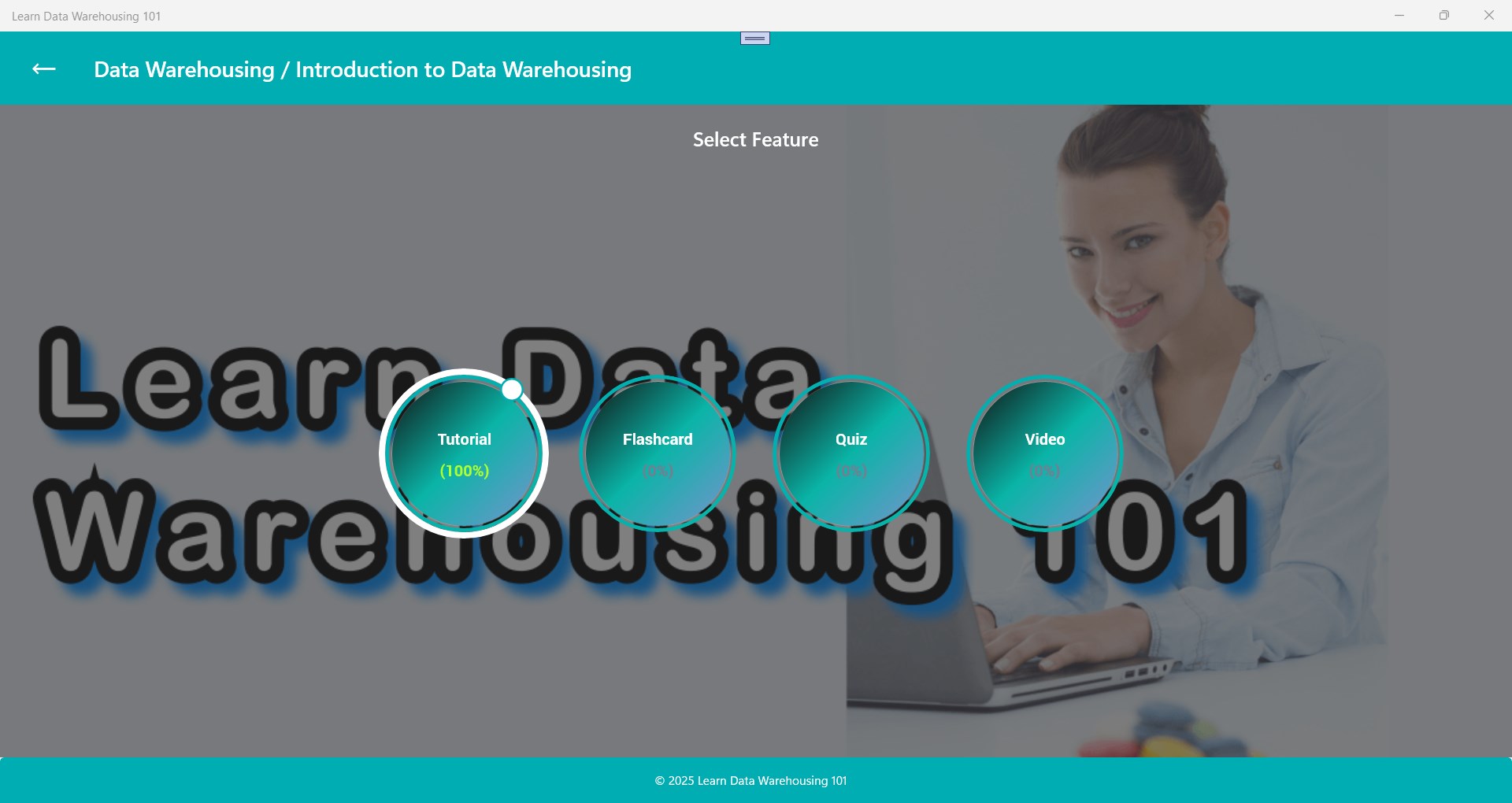
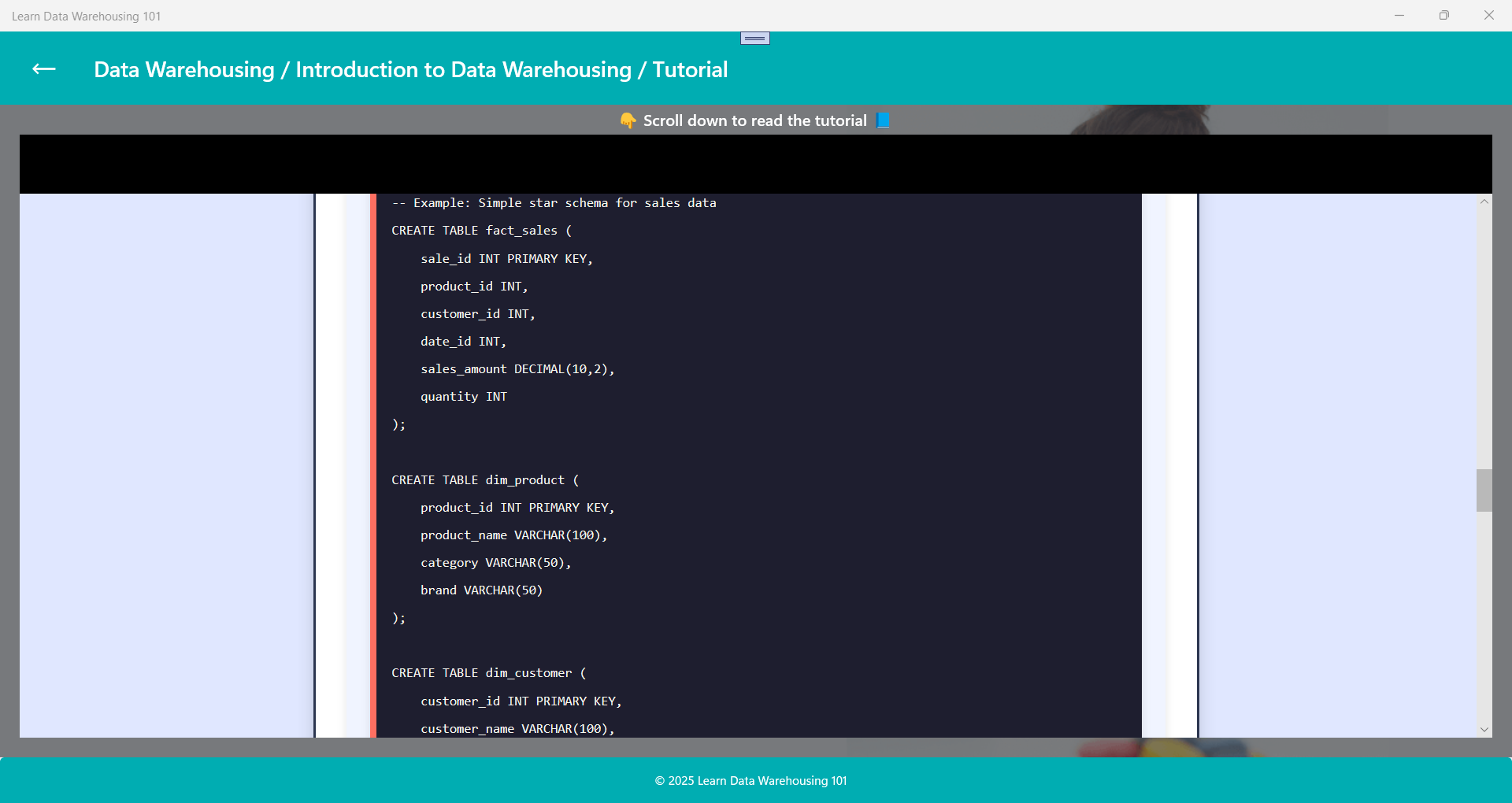
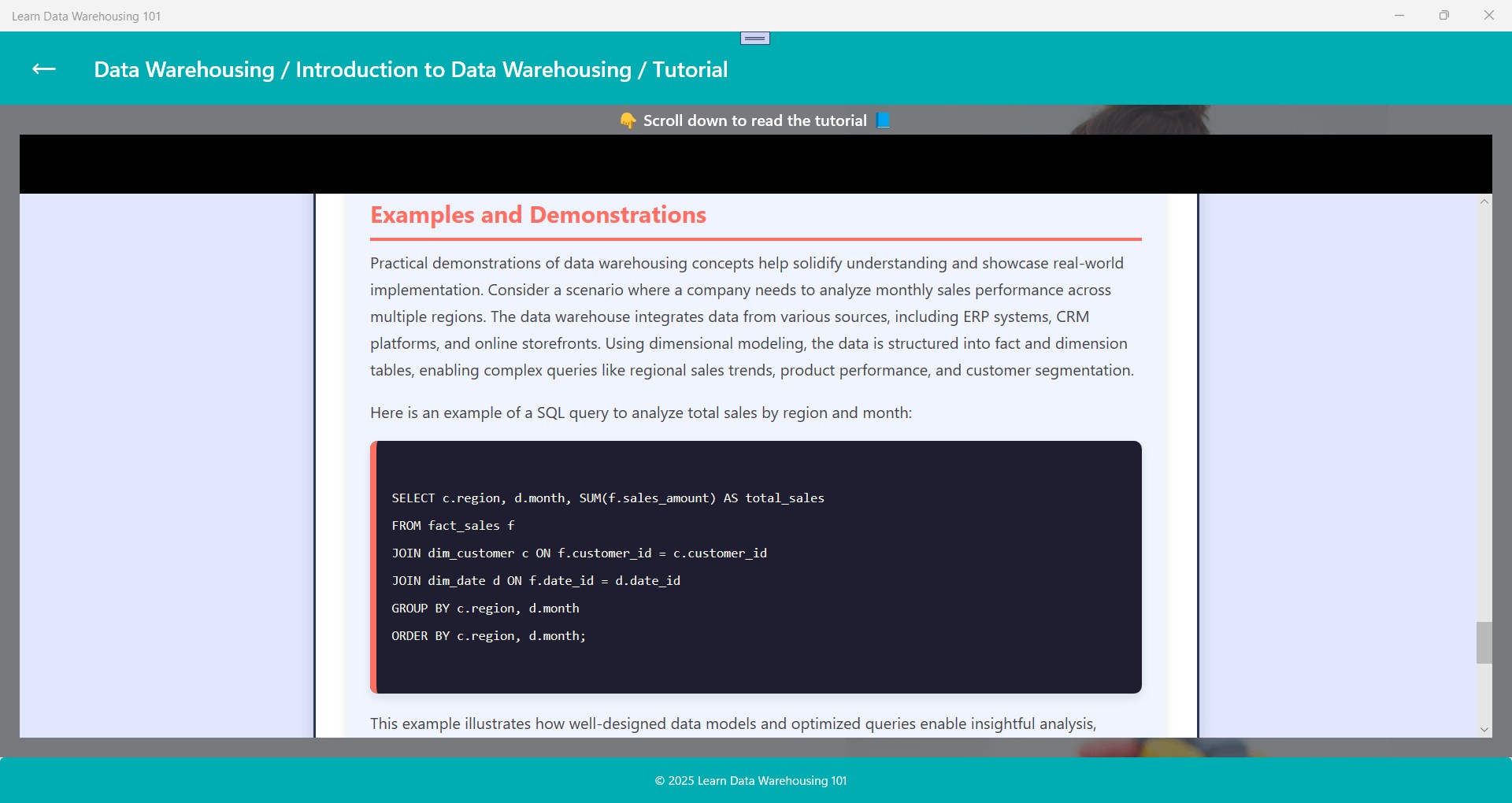
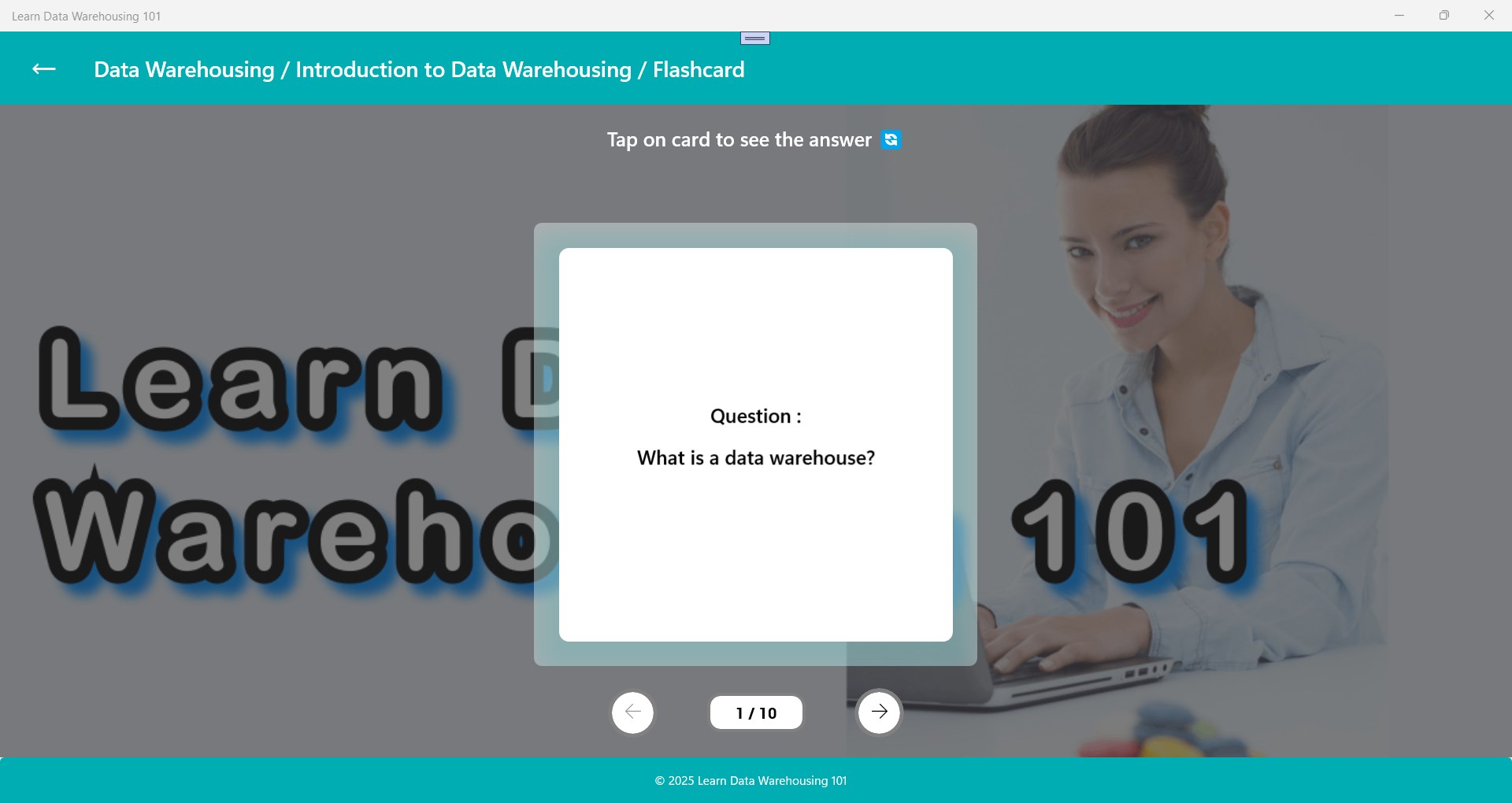
Learn Data Warehousing 101 makes it simple to master Learn Data Warehousing 101 concepts with interactive and easy-to-understand lessons. ✨ Explore and Learn through: Tutorials Flashcards Quizzes to test your knowledge Videos? ✨✨✨✨✨✨ Learn Data Warehousing 101 ✨✨✨✨✨✨ Unlock the power of Learn Data Warehousing 101 with this all-in-one learning app!
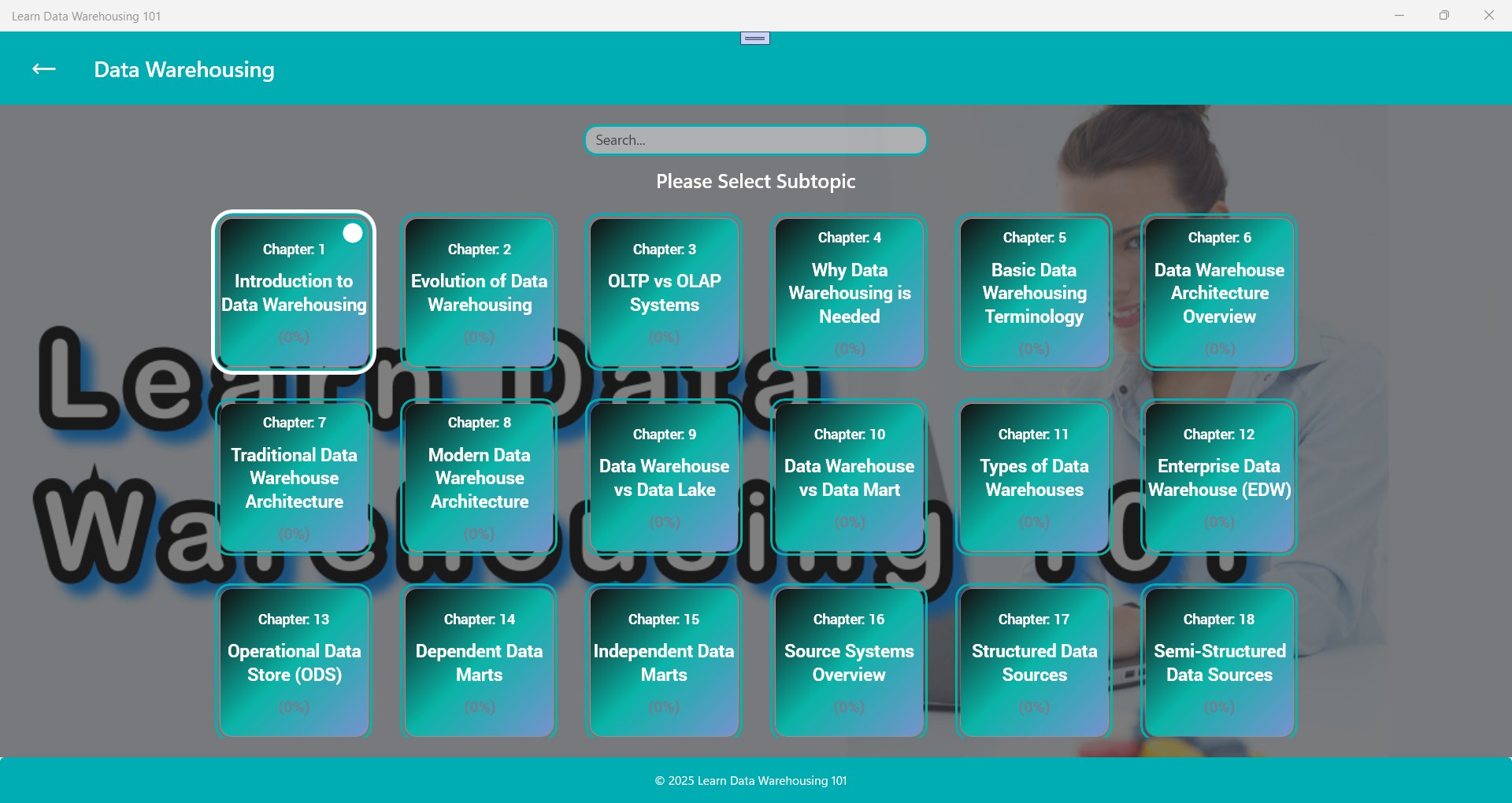
Chapters Included: From the basics to advanced concepts - everything is covered! Chapter:1 Introduction to Data Warehousing Chapter:2 Evolution of Data Warehousing Chapter:3 Oltp vs Olap Systems Chapter:4 Why Data Warehousing is Needed Chapter:5 Basic Data Warehousing Terminology Chapter:6 Data Warehouse Architecture Overview Chapter:7 Traditional Data Warehouse Architecture Chapter:8 Modern Data Warehouse Architecture Chapter:9 Data Warehouse vs Data Lake Chapter:10 Data Warehouse vs Data Mart Chapter:11 Types of Data Warehouses Chapter:12 Enterprise Data Warehouse (Edw) Chapter:13 Operational Data Store (Ods) Chapter:14 Dependent Data Marts Chapter:15 Independent Data Marts Chapter:16 Source Systems Overview Chapter:17 Structured Data Sources Chapter:18 Semi-Structured Data Sources Chapter:19 Unstructured Data Sources Chapter:20 Data Integration Concepts Chapter:21 Etl vs Elt Chapter:22 Extract Phase in Detail Chapter:23 Transformation Techniques Chapter:24 Load Strategies Chapter:25 Batch Processing Chapter:26 Incremental Loading Chapter:27 Change Data Capture (Cdc) Chapter:28 Data Cleansing Techniques Chapter:29 Data Validation Rules Chapter:30 Handling Missing and Invalid Data Chapter:31 Dimensional Modeling Overview Chapter:32 Facts and Dimensions Chapter:33 Star Schema Design Chapter:34 Snowflake Schema Design Chapter:35 Fact Table Types Chapter:36 Dimension Table Types Chapter:37 Slowly Changing Dimensions (Scd) Chapter:38 Scd Type 1 Chapter:39 Scd Type 2 Chapter:40 Scd Type 3 Chapter:41 Surrogate Keys Chapter:42 Degenerate Dimensions Chapter:43 Junk Dimensions Chapter:44 Conformed Dimensions Chapter:45 Time Dimension Design Chapter:46 Aggregate Tables Chapter:47 Data Warehouse Indexing Strategies Chapter:48 Partitioning in Data Warehouses Chapter:49 Data Compression Techniques Chapter:50 Query.
Features
Performance Optimization Chapter:51 Olap Cubes Overview Chapter:52 Molap, Rolap, Holap Chapter:53 Cube Design Concepts Chapter:54 Measures and KPIs Chapter:55 Metadata Management Chapter:56 Data Lineage Chapter:57 Data Quality Management Chapter:58 Master Data Management (Mdm) Chapter:59 Refer. The interface is organized for quick access to the most frequently used functions, reducing the time needed to complete common tasks. Advanced options are available for users who want to customize their experience and optimize the application for their workflow. Data sync and backup features help users keep their information safe and accessible across multiple devices when needed.
The application supports a wide range of file formats and integrates with popular services to extend its usefulness. Performance optimization ensures smooth operation even on older hardware, making it accessible to a broad user base. Comprehensive documentation and in-app guidance help new users get started quickly while power users can explore advanced capabilities. Users can organize content, apply filters, and access key functions through an intuitive layout that minimizes learning curve. Cross-platform support and cloud integration extend the application's reach across different devices and ecosystems. Built-in tutorials and contextual help ensure that users can discover and master features at their own pace.
The interface is organized for quick access to the most frequently used functions, reducing the time needed to complete common tasks. The application supports a wide range of file formats and integrates with popular services to extend its usefulness. The interface is organized for quick access to the most frequently used functions, reducing the time needed to complete common tasks. Advanced options are available for users who want to customize their experience and optimize the application for their workflow. Data sync and backup features help users keep their information safe and accessible across multiple devices when needed.
Pros
- User-friendly interface for smooth experience
- Comprehensive feature set for various needs
- Regular updates and maintenance
- Widely used and well-reviewed
- Good value for the functionality offered
Cons
- May have a learning curve for new users
- Some features may require subscription
- Performance may vary by device
- Interface design could be improved
- Support availability may be limited
Top Software

AAVV CHAT
AAVV CHAT is a secure and simple chat application designed for private communication over ...
Actual Budget
Actual Budget is a fast, privacy-focused finance app based on the Envelope Budgeting metho...

AppControl Manager
✨ AppControl Manager is a modern secure app that provides easy to use graphical user inter...

Arattai
A safe space to connect with your friends and family Arattai is an easy-to-use instant...

Athan App
An Athan App that sends notifications to your desktop based on your location and settings....

BetterLyrics
* The free trial version is identical to the paid version — no feature limitations. ? Bet...

BPTrakr - Blood Pressure Tracker
BPTrakr - Blood Pressure Tracker for Windows. Designed expressly for Microsoft Windows des...

Christmas Snowfall
From the makers of the highly rated Peaceful Snowfall comes Christmas Snowfall featuring b...
Similar Apps

Dictionary Pro by Farlex
Dictionary PRO gives you the power of the world's most comprehensive dictionary with offli...

Evangelical Heritage Version Study Bible - Microsoft Store Edition
The Evangelical Heritage Version (EHV) is a new translation of the Bible published by The ...

rbook
A simple ebook reader with a clean interface. Supported formats: - epub

Bible - Multi Version
"Shepherd Bible" is a fast, lightweight, offline Bible for your daily study. It allows you...

Bible 300
Ad-free Bible reader app. Use it off-line, Internet connection is not required for reading...

Bible by Olive Tree
Studying the Bible shouldn’t be hard. The Olive Tree Bible App equips you with easy-to-use...

CTU Flexible Learning
Welcome to the CTU Flexible Learning experience specially designed for our students and fa...

Handy Art Reference Tool
"Thanks to this useful app, drawing realistic hands can become a whole lot easier" - Imagi...